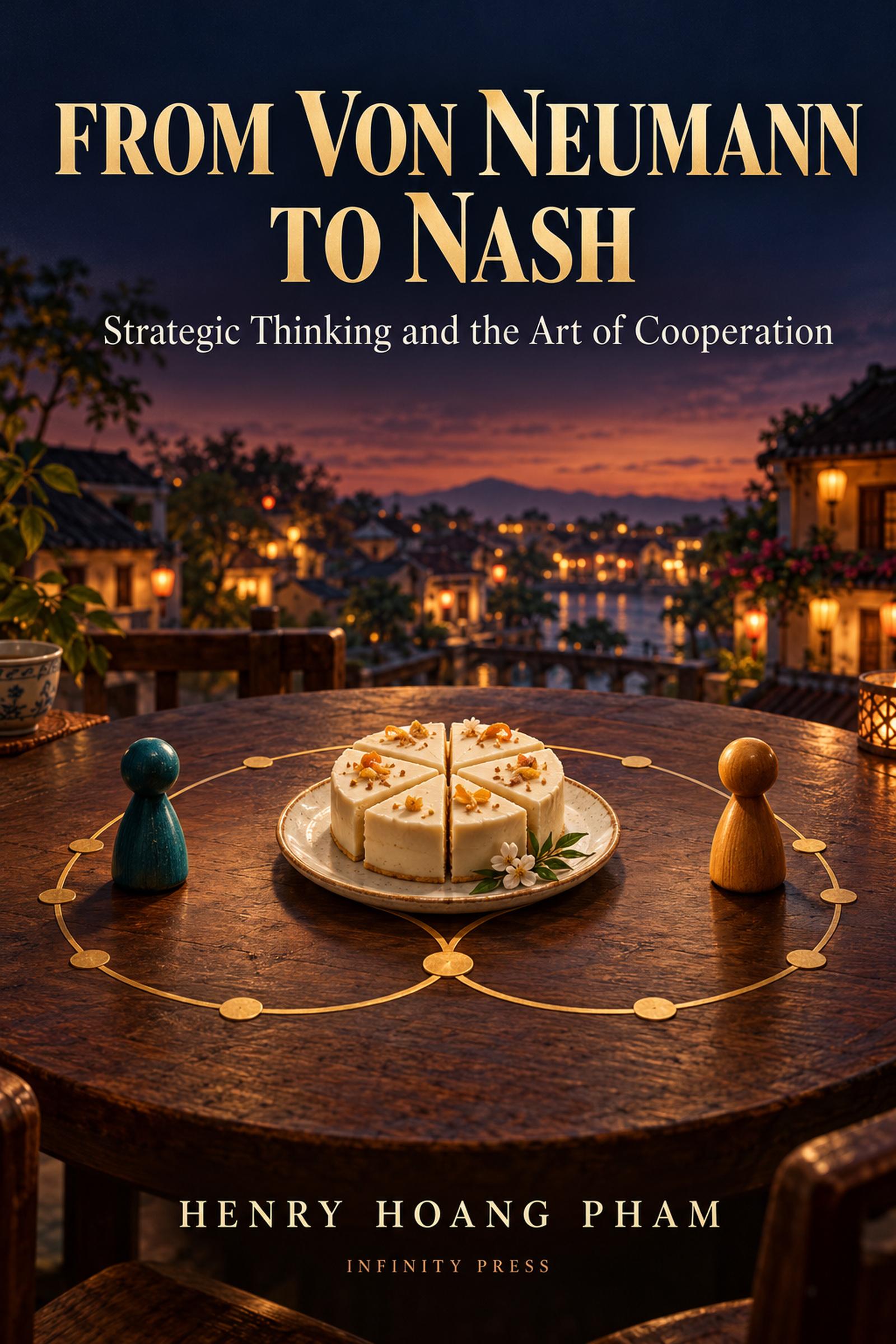
Stratefic thinking: From von Neumann to Nash
Strategic Thinking and the Art of Cooperation
You will sign in with your email first.
About this edition
Source text: Henry Hoang Pham, Từ von Neumann đến Nash: Tư duy chiến lược và nghệ thuật hợp tác, Infinity Press, 2026. Original work supplied for this catalog entry as Tu-von-Neumann-den-Nash_Tieng-Viet.epub; publication date in EPUB metadata: 2026-10-25.
Translation source: Author-supplied English edition: From-von-Neumann-to-Nash_English.epub. Title: From von Neumann to Nash: Strategic Thinking and the Art of Cooperation. Henry Hoang Pham; Infinity Press; 2026-10-25. No separate translator is credited in the supplied EPUB.
Rights: © 2026 Henry Hoang Pham, as stated in all three supplied EPUBs. The author has requested creation of this book and its Vietnamese, English and Japanese editions on Infinity Press at price 0. This is an original copyrighted work; no public-domain or Creative Commons status is claimed. This record covers the supplied editions, not reproduction of the works cited in the bibliography.
Territories: Worldwide online distribution through Infinity Press.
Review scope: Sample
Approved on: Oct 25, 2026
Version notes: English edition, 2026. 24 stories in four parts, with a preface, historical afterword, glossary and further reading. © 2026 Henry Hoang Pham. Published by Infinity Press.
Twenty-four short stories about sharing, promises, fairness and cooperation. Follow sisters Mai and An through everyday choices that introduce the central questions of game theory, with room for younger readers and adults to think together.
What makes a fair share? Why can two sensible decisions leave everyone worse off? And when is keeping a friend more valuable than winning one more game? In 24 short tales, Henry Hoang Pham follows sisters Mai and An and their neighbours as they divide cakes, play marbles, borrow scissors, run a fair and share a well during the dry season. Small disagreements open onto larger questions about incentives, trust, bargaining and cooperation. The stories give younger readers familiar situations to explore while leaving adults room to consider work, relationships and the rules we live by. Each chapter ends with a question that invites conversation. A brief historical afterword and an accessible glossary connect the tales with game theory, including zero-sum games, mixed strategies, minimax, Nash equilibrium and the challenges of managing shared resources. From von Neumann to Nash can be read a chapter at a time or shared aloud. Its recurring question is simple: how can we choose well when other people are choosing too? Published by Infinity Press in 2026. Dedicated to the author's daughter, Suri.
Who it is for
Readers new to game theory; children reading with adults; families, teachers and curious readers interested in strategic thinking, fairness, negotiation and cooperation. No advanced mathematics is needed.
Key ideas
- 01
Interdependent choices
A useful move depends on what other people may choose.
- 02
Minimax and mixed strategies
Consider the worst case and avoid making every move predictable.
- 03
Nash equilibrium
No player benefits by changing alone while the others keep their choices, but the outcome need not be fair or best for everyone.
- 04
Trust and repeated games
Actions and future encounters give promises their weight.
- 05
Bargaining and interests
Understanding what each side values can reveal better ways to share.
- 06
Rules and shared resources
The rules shape how people contribute, benefit and care for what they hold in common.
Questions and answers
Is this a translation of a book by von Neumann or John Nash?
No. It is an original book by Henry Hoang Pham that explores ideas from game theory through short stories.
Do I need to know advanced mathematics?
No. The book starts with everyday situations, with an accessible glossary for readers who want to explore the concepts further.
What does the book contain?
Twenty-four short chapters in four parts, each ending with a question, plus a preface, historical afterword, glossary and further reading.
Is it suitable for children?
Children can follow the stories and discuss them with adults. The questions about fairness, trust and cooperation also invite reflection from older readers.
What are the price and edition languages?
The book is listed at price 0 in Vietnamese, English and Japanese editions. Copyright remains with Henry Hoang Pham.
Reader reviews
No reviews yet.