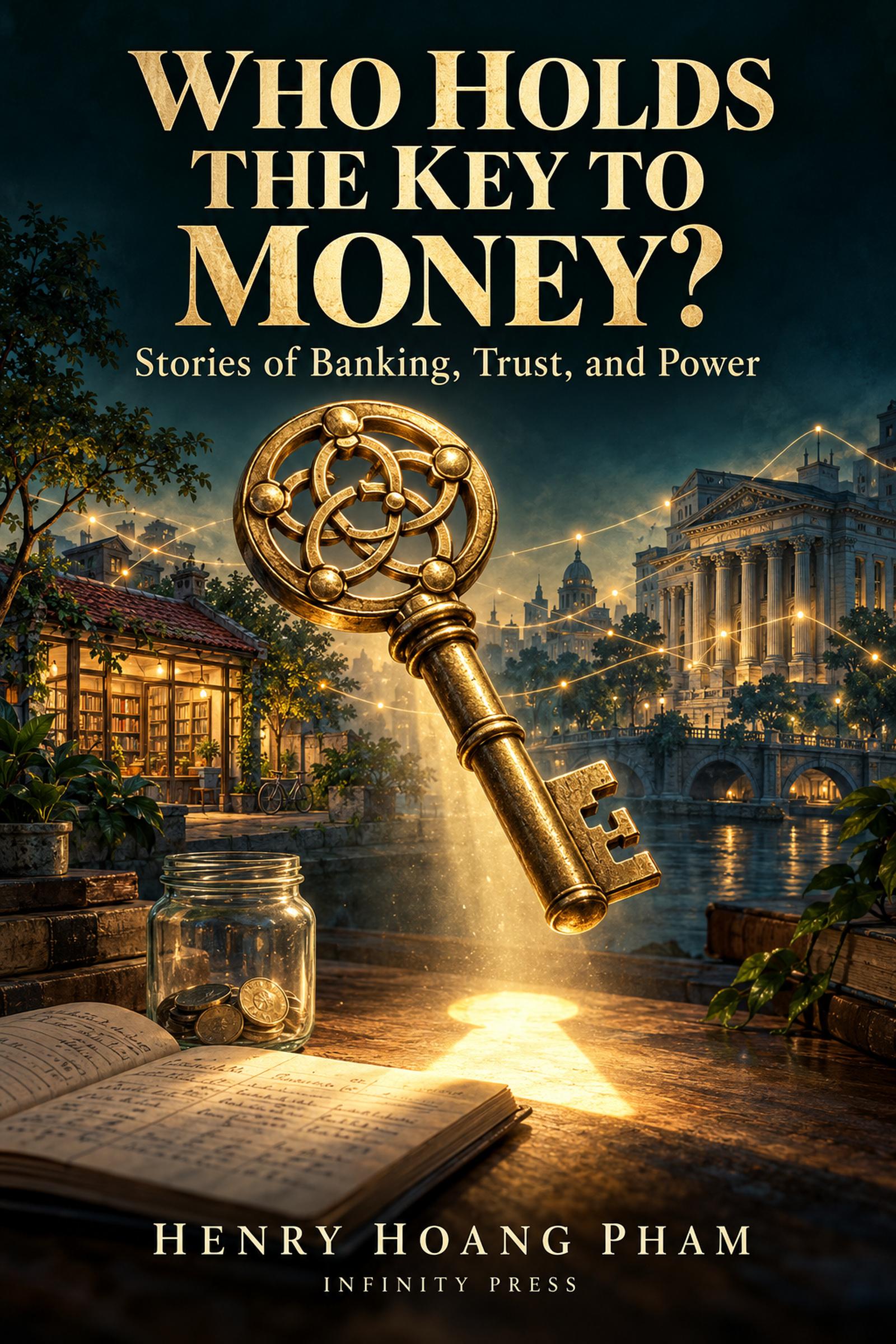
Who Holds the Key to Money?
Stories of Banking, Trust, and Power
You will sign in with your email first.
About this edition
Source text: Ai giữ chìa khóa của tiền? - original Vietnamese manuscript by Henry Hoang Pham, Infinity Press, 2026.
Translation source: Who Holds the Key to Money? - AI-assisted English version prepared from the original Vietnamese manuscript, Infinity Press, 2026.
Rights: © Henry Hoang Pham, 2026. Original work created for Infinity Press with the author’s authorization; referenced economic texts are discussed, not reproduced.
Territories: Worldwide
Review scope: Not reviewed
Approved on: Oct 29, 2026
Version notes: First English edition, 2026. Cover and EPUB pending upload.
Twenty-four short stories about money, banks, inflation, bank runs and financial power. Mai, An and their neighbours make difficult economic ideas accessible to younger readers and thought-provoking for adults.
Can a paper ticket become money? What happens when everyone wants to withdraw their savings at once? And who should watch the people entrusted with other people’s money? Who Holds the Key to Money? returns to Mai, An and their friends in a Vietnamese neighbourhood where a leaking reading-room roof sparks a community fundraiser. As the money travels between people, jars, accounts and promises, the children begin asking larger questions: what gives money value, how banks create credit, why prices rise, how crises spread, and who holds financial power accountable. Henry Hoang Pham tells these questions through 24 short chapters in four parts, inviting children and adults to consider different answers together. An analytical afterword compares arguments and counterarguments inspired by Adam Smith, Walter Bagehot, Louis Brandeis, John Maynard Keynes and G. Edward Griffin, distinguishing documented history from contested interpretations and conspiracy claims. The book is an original work, not a translation of the books it discusses. Includes a glossary and reading list. Published by Infinity Press, 2026.
Who it is for
Young readers and families; teachers and students; adults new to economics; and experienced readers interested in money, banking, inflation, financial crises, institutional trust and accountability. No previous knowledge of economics is required.
Key ideas
- 01
Money and trust
A note or bank balance is useful because people expect it to be accepted and retain purchasing power.
- 02
Banks and credit
Deposits, loans, payments and reserves create useful services alongside real risks.
- 03
Inflation and fairness
Changing prices can affect savers, borrowers and wage earners in unequal ways.
- 04
Bank runs and stability
Even a bank with valuable long-term assets can struggle when many depositors demand cash simultaneously.
- 05
Power and accountability
Those handling other people’s money need transparency, rules and effective oversight.
- 06
Arguments and counterarguments
Separate verified events from interpretations and speculation about financial institutions.
Questions and answers
Is this a translation of The Creature from Jekyll Island?
No. It is an original book by Henry Hoang Pham that examines and challenges ideas from several works on monetary history and banking.
Can children understand a book about banking?
Yes. The stories follow familiar characters and everyday situations, with deeper questions for older readers.
Does the book claim that central banking is a conspiracy?
No. It distinguishes documented historical facts from disputed interpretations and presents competing arguments.
How is the book organised?
Twenty-four short chapters in four parts, followed by an analytical afterword, glossary and further reading.
Which languages and price are available?
Vietnamese, English and Japanese editions are registered at price 0. Cover and EPUB files will be added before publication.
Ideas and articles about this book
Idea
What happens if everyone withdraws their money at once?Banks cannot necessarily pay every depositor in cash immediately because many funds support longer-term loans. A wave of withdrawals can turn fear into a liquidity crisis, even at a bank with valuable assets.
Idea
Who holds the people handling our money accountable?Good intentions are not enough. Clear rules, transparent reporting, independent audits, effective supervision and public scrutiny matter. The supervisors themselves must also be accountable.
Idea
Why can a piece of paper become money?Because people expect others to accept it in exchange and trust that it will retain some purchasing power. Money also relies on institutions, production and the promises behind the payment system.
Article
How Is Money Created? Banks, Trust, and PowerFrom Mrs Tu’s cake vouchers to bank balances, everyday stories explain how money and credit work, what inflation changes, and why financial power needs oversight.
Reader reviews
No reviews yet.