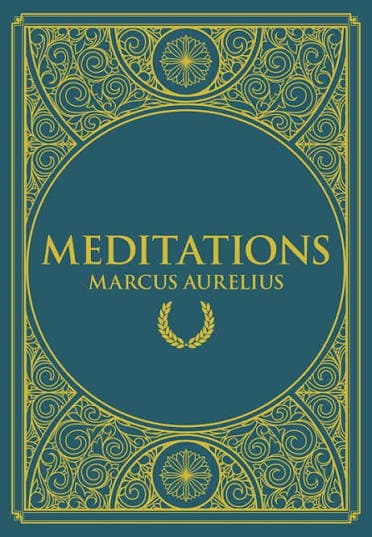
Meditations
Reflections on virtue, reason, and inner freedom
You will sign in with your email first.
About this edition
Source text: Marcus Aurelius, Meditations, in twelve books. Source EPUB: marcus-aurelius_meditations_george-long_advanced.epub, Standard Ebooks. EPUB metadata cites http://classics.mit.edu/Antoninus/meditations.html and http://books.google.com/books?id=i9iUswYUMmUC. These references describe the supplied English text sources; a Greek source edition is not identified in the EPUB metadata.
Translation source: English translation by George Long. Digital publisher: Standard Ebooks. Source edition: https://standardebooks.org/ebooks/marcus-aurelius/meditations/george-long . EPUB publication date: 2014-05-25; modified: 2026-09-07. Language: en-GB.
Rights: The supplied EPUB states that its source text and artwork are believed to be in the United States public domain. It states that Standard Ebooks contributors dedicate their contributions under CC0 1.0 Universal: https://creativecommons.org/publicdomain/zero/1.0/ . The EPUB also instructs users outside the United States to check local laws. Source of this note: dc:rights in the supplied EPUB metadata. This records the source’s rights statement; independent editorial rights review has not been completed.
Territories: United States (US), matching the initial offer. Additional territories require review.
Review scope: Not reviewed
Approved on: Oct 21, 2026
Meditations by Marcus Aurelius is a classic of Stoic philosophy, collecting twelve books of personal reflections on virtue, judgment, and everyday life. The English edition uses George Long’s translation.
Meditations brings readers into the inner life of Marcus Aurelius, a Roman emperor reflecting on how to live well amid duty, uncertainty, and conflict. Written as personal reminders rather than a systematic treatise, its twelve books explore the practice of Stoic philosophy in everyday life. Again and again, Marcus returns to the judgments we make, the actions within our power, and our responsibilities to other people. His reflections address anger, ambition, adversity, mortality, and the challenge of remaining fair and compassionate when circumstances are difficult. This English edition uses George Long’s translation and the digital text prepared by Standard Ebooks. Its brief, sometimes recurring passages invite slow reading and reflection, offering a practical companion for readers interested in virtue, self-discipline, and a thoughtful life.
Who it is for
Readers exploring Stoic philosophy; anyone reflecting on resilience, responsibility, or mortality; and readers who enjoy short philosophical passages for regular contemplation. George Long’s translation uses a formal, older style of English.
Key ideas
- 01
Judgment and response
Examine your judgments and choose how to respond to events.
- 02
Virtue in action
Practice wisdom, justice, courage, and self-restraint through everyday conduct.
- 03
Shared humanity
Treat others with patience and act for the common good.
- 04
Impermanence
Remember that life, reputation, and possessions are temporary.
- 05
Attention to the present
Focus on the task and responsibility before you.
Questions and answers
What is Meditations about?
Meditations explores how to live with reason, virtue, and a sense of responsibility. Its short reflections address judgment, anger, adversity, human relationships, and mortality.
Who wrote Meditations?
Marcus Aurelius, the Roman emperor and Stoic thinker, wrote these reflections as personal reminders to himself.
Which translation does the English edition use?
The English edition uses George Long’s translation, with the digital text prepared by Standard Ebooks. It contains twelve books and endnotes.
How were the Vietnamese and Japanese editions translated?
The Vietnamese edition is based on George Long’s English translation. The Japanese edition follows the Vietnamese text.
Is Meditations suitable for beginners in Stoicism?
Its short passages allow readers to start with a few reflections at a time. Some ideas recur or draw on ancient philosophical assumptions, and George Long’s English has a formal, older style.
How should I read Meditations?
Read in sequence or choose a few passages each day. Pause to consider a concrete situation in your own life, and revisit passages as your understanding develops.
Ideas and articles about this book
Idea
How can remembering life is finite change what we do today?Awareness of limited time can help us stop postponing a good action. Rather than doing everything, choose something worth doing and give it your attention.
Idea
How can we deal with difficult people without losing our kindness?Expect that others may behave badly without immediately treating them as enemies. Stay fair, state your boundaries, and look for cooperation where it is possible.
Idea
How can we respond calmly to events we cannot control?Marcus Aurelius asks us to examine the judgment we add to an event, then choose a fair and useful response. Calm begins with that pause; it does not require ignoring a real problem.
Article
How to Read Meditations: A Beginner’s GuideUnderstand the form of Marcus Aurelius’s Meditations, read passages in context, and turn reflection into thoughtful action rather than simply collecting quotations.
Article
Three Everyday Stoic Practices Inspired by MeditationsPrepare for a difficult encounter, examine a judgment when plans change, and stop postponing one worthwhile action: three editorial exercises drawn from Meditations.
Reader reviews
No reviews yet.